
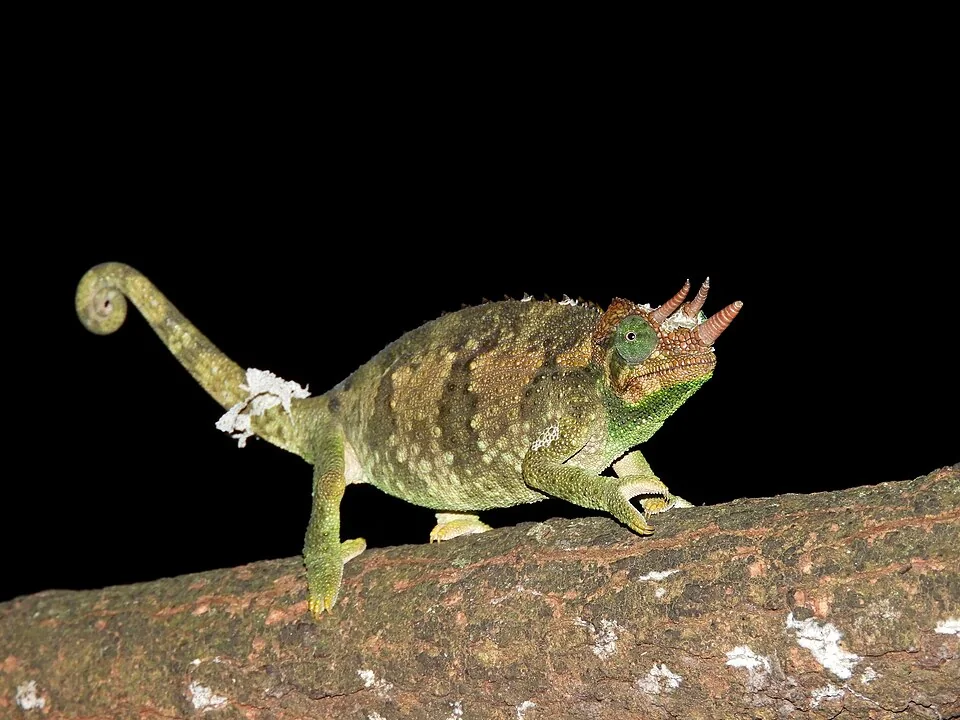
Jackson’s chameleon
Trioceros jacksonii
Photo: Trioceros jacksonii 114285602 · Marius Burger · CC0 · Changes and credits
These guides provide general husbandry information and do not replace veterinary assessment. If your animal shows symptoms or its condition worsens, contact a veterinarian experienced with exotic animals.
- Warm zone
- Warm perch: 26–29 °C
- Cool zone
- Cool air: 22–24 °C
These notices cover the cited provisions, not every possible national or local rule. Check additional requirements with the competent authority.
Description
Trioceros jacksonii is an arboreal East African chameleon also associated with montane habitats. Males in many populations have three head horns; horn development and size vary between subspecies and sexes. It is diurnal and insectivorous and, unlike many chameleons, females give birth to live young.
Behaviour
Response to contact varies: observe the individual’s stress signals.
Housing together
Keep one chameleon per enclosure and use visual barriers between adjacent enclosures so it can avoid seeing other animals. Do not permanently house a male and female together. Supervise breeding introductions and end them if the female flees, threatens or is chased.
Enclosure and climate
The climate conditions in this sheet refer to Trioceros jacksonii xantholophus. Provide a tall, ventilated enclosure with slender branches, dense foliage and a dripper; collect excess water without leaving pools on the floor. Retain the night-time temperature drop specified in the climate chapter. Other subspecies are outside the scope of this climate profile.
Night: 10–18 °C.
Setup
Install the dripper above reachable leaves and prepare an accessible drain for excess water.
Making height usable
Secure horizontal, sloping and vertical branches to the structure, using diameters that offer grip and supports suitable for adult weight. Connect them from the exposed lighting branch to the cool area, distributing supports across levels. Place hide entrances beside branches; add foliage along routes without blocking dishes, doors or vents.
Testing and access
Connect specified heat sources to compatible thermostats and guard against contact. Secure probes according to device instructions; measure air at resting sites and heated surfaces separately with independent instruments. In housing with water, also check water temperature and quality: one zone’s thermostat does not control the others.
With the complete enclosure running, record day and night readings and compare them with the sheet. Test doors, cable openings and cleaning access, keeping vents clear. Change one variable at a time and recheck after each adjustment.
Lighting and UVB
Zones 2–3: intermediate assignment between partial exposure and more open basking.
One UVI peak is not verified for this entry. Adjusting the installation requires a target for the identified species and origin; the layout should provide screened areas and voluntary light access. A missing number does not establish that UVB is useless.
UVB is essential in indoor housing. Outdoors, direct sunlight can provide it if shade is always accessible. Select the lamp to achieve the appropriate UVI at the positions the animal uses.
UVA is recommended as part of daytime lighting, including when UVB has not been shown to be indispensable. Check the UVB source’s spectrum, as it may already emit UVA: a second lamp is not automatically necessary.
Linear UVB tube with reflector, sized once species UVI is established; no single verified percentage for this entry.
For maintenance, a cycle of approximately 12 hours of light and 12 hours of darkness can serve as an initial reference. Use a timer to switch lights off at night, and keep retreats available so the animal can withdraw from light during the day. Adapt day length to species and origin, following the specific guidance for seasonal care and breeding.
Light in the animal’s daily life
The available numeric entry concerns xantholophus; this profile does not assume that form. Identify subspecies and origin and check casque, upper branches and mesh.
An example layout in the enclosure
To make the layout concrete, take housing measuring 61 × 61 × 122 cm, using the first dimensional configuration in the sheet. This is a mounting example: retain the conditions and any alternatives attached to the stated minimum.
In a wooden enclosure with internal lighting, imagine the tube 117 cm above the floor and the back or head at 77 cm. The geometric distance is therefore 40 cm. The branch or platform lies below animal height, according to body size. Place lighting over one side, with a route to fully screened retreats.
In a glass enclosure with a mesh roof, retain the same animal height and imagine the tube 5 cm above the mesh: distance becomes 50 cm. Mesh attenuates UV variably; ordinary glass roofs block UVB. Increasing the percentage alone is insufficient: measure beneath the mesh and adjust height, output or layout as needed.
These distances describe the example, not a safe clearance for every lamp. First establish a verified UVI target for the identified taxon. Also respect the minimum clearance specified for the model used. Recheck with furnishings, guards and mesh installed, including the highest reachable points and animal growth.
Choosing and checking lighting
First define the patch that should illuminate the whole body and the route to a screened retreat. For a broad patch, select a linear tube with reflector; consider a compact only if its useful patch covers the body and leaves an accessible gradient. Check model, output, reflector and mounting distance, then compare measured UVI with the species target. Label UVB percentage alone cannot determine distance and intensity.
The decisive check uses a UVI metre facing the source at animal height. Check the centre and edges of the exposed patch, the highest supports and retreats, which must allow withdrawal from UV. Repeat after moving equipment, changing lamps and plant growth. Without a metre, use the manufacturer’s instructions and measurements for the exact configuration, including safety clearances.
When UVB or UVA are absent
If the UVB source fails, restore the installation and recheck the exposed area. Oral D3 may be considered as temporary support but is not a complete or universally safe replacement. Consider calcium, D3, diet and animal condition together: avoid improvised extra doses.
UVA contributes to environmental perception and behaviour and cannot be replaced by vitamins or calcium. A reptile UVB source normally also emits UVA: check its declared spectrum. If the existing lighting lacks it, complete the installation with a suitable source; an ordinary white LED does not guarantee UVA and a UVA-only lamp does not provide UVB.
Humidity and ventilation
For T. j. xantholophus provide leaf droplets and a dripper with drainage. Distribute misting without leaving standing water; retain ventilation and the night-time temperature drop rather than keeping the enclosure warm and saturated. Measure beside resting branches by day and night and allow daytime surface drying.
Feeding
Trioceros jacksonii: varied insects and controlled portions. Females may produce eggs or young even when breeding is not intended: overfeeding does not prevent deficiencies and can increase reproductive problems.
Recommended foods
The tiers describe dietary use: rotate foods within each tier rather than treating them as an absolute nutritional score.
| Food | Dietary role | Benefits and limits | Preparation |
|---|---|---|---|
| Crickets and locusts | Main choices | Supply protein and encourage hunting; calcium is low relative to phosphorus, so preparation and supplementation are needed. | Use captive-bred insects and gut-load them as described below. Select suitably sized feeders, place the meal’s batch in a clean container and apply a thin calcium coating immediately before offering them. |
| Feeder roaches | Main choices | These feeders provide a useful second protein source for rotation, but do not constitute a complete diet or replace calcium supplementation. | Offer well-fed soft nymphs sized to the mouth; avoid excessively hard adults. |
| Silkworms and black soldier fly larvae | For rotation | Diversify texture and nutrients. Black soldier fly larvae can supply more calcium, but content depends on rearing: they do not make the entire diet complete. | Choose appropriately sized feeder larvae. Keep silkworms on their specific food; check the supplier’s supplementation guidance. |
| Waxworms, mealworms and superworms | Occasional | Fat-rich larvae concentrate energy and often contain little calcium: use as a small part of variety, not the sole food. | Replace part of the meal instead of adding them to a full ration. Avoid hard or oversized larvae for small animals. |
| Wild insects, fireflies and contaminated prey | Avoid / not a staple | May carry pesticides, parasites or toxins; a healthy appearance does not establish safety. | Use traceable feeder cultures; do not collect insects beside roads or treated gardens. |
Comparable nutritional values
Protein, fat, calcium and phosphorus are percentages of dry matter, excluding water; dry matter itself is a percentage of fresh weight. These are reference analytical values compiled in a clinical table, not guaranteed contents of your batch or a universal ranking. Age, rearing, feeding and supplementation change composition. Do not compare them directly with fresh-food percentages or already diluted prepared diets. Comparable numbers are not provided for other foods.
| Insect | Dry matter | Crude protein | Crude fat | Calcium / phosphorus | Ca:P |
|---|---|---|---|---|---|
| Adult house cricketAcheta domestica | 32% of fresh weight | 62.6% DM | 20.4% DM | 0.3 / 1% DM | 0.3:1 |
| Migratory locustLocusta migratoria | 31% of fresh weight | 67.5% DM | 14% DM | 0.1 / 0.7% DM | 0.14:1 |
| Mealworm larvaTenebrio molitor | 32.8% of fresh weight | 52.8% DM | 36.1% DM | 0.3 / 0.8% DM | 0.37:1 |
DM = dry matter. Ca:P describes calcium relative to phosphorus before supplementation: a protein-rich feeder may still be calcium-poor. Offered portions remain those for this species and life stage.
Meals by age and size
| Stage and size | Frequency | Amount per meal |
|---|---|---|
| About 0–6 months, rapid growth | Daily | Offer small insects in the morning in groups of 3–5, adding after capture during a supervised 5–10 minute session. Do not restrict a baby to the adult portion; monitor growth and fat. |
| About 6–12 months: slowing growth | Every other day | Up to about 10 small insects per meal during active growth; gradually reduce towards the adult portion rather than retaining large rations after growth ends. |
| Adults, generally from about 12 months | Every other day | About 3 well-fed, appropriately sized insects per meal; reduce the count when prey is larger. Do not add fatty larvae as a daily treat. |
Adjusting portions
To assess the portion, compare the amount and type of food eaten with growth and body condition. Weekly weighing of juveniles and monthly weighing of adults helps follow the trend. Adjust the ration gradually when growth or reserves require it; reduce it if body condition indicates excess weight or leftovers remain. Investigate unexpected weight loss or abnormal swelling rather than addressing it only with more or less food.
Preparing and offering meals
Prepare insects during the 24–48 hours before feeding: keep them in their culture container with a complete feeder diet and safe hydration. Check access to food and water and remove spoiled leftovers. Then select feeders of the specified size and prepare only the batch to be offered. This step, called gut-loading, improves prey quality; bran or potato alone do not correct deficiencies.
At feeding time the prey should be easy to swallow. As an initial guide, choose insects no wider than the space between the eyes, then adapt size to the mouth and the animal’s response. Offering them individually or in an escape-resistant dish lets you see actual intake and remove leftovers.
Trial amounts are a starting point for a healthy, active animal at correct temperatures: record intake and weight trend, then adjust the ration. Do not feed again merely because it continues striking at prey.
Calcium and vitamins
Immediately before feeding, lightly coat low-calcium insects with phosphorus-free calcium: they should remain visible, without clumps. Common insects often have an unfavourable calcium:phosphorus balance; rotating them alone does not correct it.
Choose one supplementation programme: plain calcium for ordinary meals and a species-appropriate multivitamin at its labelled feeding intervals. Record the product and its existing D3 and vitamin A; do not add a second dose to meals using a combined product. With measured UVB, agree the oral D3 provision; product concentrations are not interchangeable.
This species needs particular care with supplementation: swelling beneath the throat needs assessment rather than more vitamins. Do not transfer high D3 doses from species kept without UVB.
Daily care
First days
Record identity and origin and prepare separate housing. Before arrival, check closures, water and retreats. Offer the foods in the sheet and record intake, leftovers and weight. Follow a quiet maintenance routine and keep hides available, avoiding capture just to observe the animal.
Cleaning
Keep animals and equipment away from kitchens and food areas, use tools dedicated to each enclosure and wash your hands with soap and running water after handling animals, food, tank water or furnishings. Quarantine new arrivals separately and agree the duration and checks with a veterinarian before introducing them to established animals.
Handling
Prepare the transfer container near the animal with a reachable entrance. Where possible, guide it into the container without chasing it around the enclosure. Close the container before moving it and check that it is secure; do not grip the tail or limbs and limit contact to necessary transfers.
Checks
Weight loss, weakness, injuries or abnormal breathing warrant veterinary assessment.
Record appetite, droppings and environmental changes; a check is not an automatic treatment.
Breeding
Sex, maturity and readiness
Identify subspecies: horn presence and development differ and do not always replace sex confirmation. Females need adult structure and reserves for a long pregnancy; prepare individual housing and tiny live food.
Start a record for each breeding animal with identity, origin, documented age and previous weights. Compare the weight trend with growth and body condition; delay introductions for animals still growing rapidly, losing weight or recently acquired. Use stated ages as guidance alongside these checks. If sex cannot be identified reliably, obtain assessment by qualified personnel before pairing.
Preparation and seasonal cycle
Maintain montane conditions with cool nights and hydration rather than increasing heat to shorten pregnancy. Briefly present a pair under observation and separate at rejection. After a successful encounter, avoid permanent male-female cohabitation.
Before encounters, prepare and test offspring enclosures and have first foods available. Check records for regular adult feeding and good body condition, then verify access from exposed areas to retreats. If the species protocol includes seasonal changes, adjust settings gradually and record the response. Record night-time air, surface and egg temperatures separately, noting where each is measured. Keep water available throughout preparation.
Courtship and mating
Introduce only identified, compatible adults, with another enclosure ready. Observe from a distance and end the encounter if you observe persistent pursuit, injuries or an animal unable to move away from its partner; do not forcibly separate animals during copulation. Record the date, both identities and what you actually saw: courtship, contact or mating alone does not prove fertilisation.
Pregnancy and preparation for birth
Females give birth to live young; no egg-laying bin is needed. Pregnancy often lasts 6–9 months, but stored sperm and an unobserved start make dating from the last mating imprecise. Provide many branches and leaves and discreetly monitor appetite.
Gestation and birth
Young are expelled in membranes that adhere to branches or leaves and open during initial movements. Prepare safe vegetation and flooring without deep basins. Do not mistake membranes for eggs needing incubation or attempt to force birth.
Maintain the usual gradient, shelters and free access to water; the female must be able to move away from warmth. Prepare a cleanable surface and observe without repeatedly moving her. Count offspring after birth has finished; do not pull membranes, cords or still-attached young. Remove birth material after the animals have separated.
First meals and juvenile care
Once mobile, transfer youngsters to individual ventilated enclosures with twigs and fine droplets. Offer fruit flies and pinhead crickets already available; neonates cannot wait for a culture to become productive. Retain cool nights and check dehydration and overheating.
During the first weeks, monitor each youngster: a feeding group does not guarantee that every individual eats. Record intake, droppings and weight at regular intervals to follow growth and adapt housing and food size. Provide separate accommodation if competition prevents an individual from feeding or size differences become marked. Document repeated independent meals before transfer to another keeper.
Female recovery
After reproduction provide water and the usual balanced diet, initially in manageable portions; monitor weight, activity and return of appetite. Keep supplements and lighting consistent with the feeding guide. Avoid further introductions until the previous condition has recovered; later clutches may occur without another mating. Persistent straining, weakness or protruding tissue require veterinary attention, without squeezing the abdomen.
Equipment and example diary
Prepare the female’s enclosure, dividers or neonatal enclosures according to the species’ social structure, shelters, accessible water, thermostat and probes, scales and first foods. An incubator is unnecessary: reserve space and time for monitoring offspring and mother.
A consistent diary using actual dates helps follow reproduction in Trioceros jacksonii. Start with adult identity, weight and condition, then record observed encounters, laying or birth and development conditions. After emergence record the first meal actually accepted and each youngster’s growth while continuing to follow female recovery. Over time these records help identify your lineage’s pattern without turning approximate durations into deadlines.