
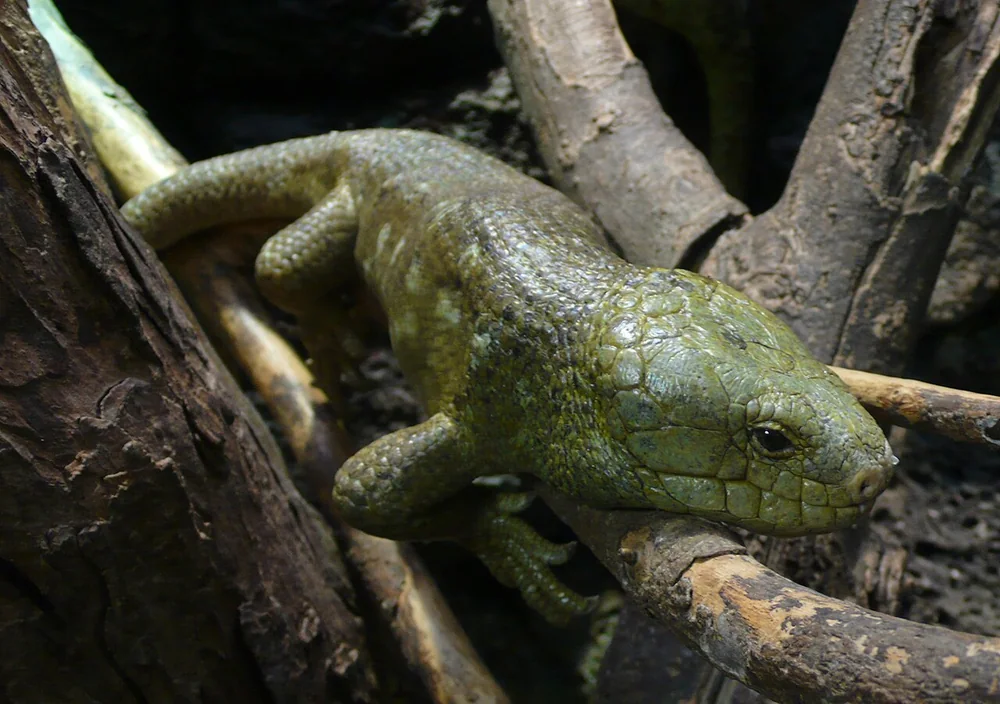
Solomon Islands skink
Corucia zebrata
Photo: Corucia zebrata (2) · TimVickers · Public domain · Changes and credits
These guides provide general husbandry information and do not replace veterinary assessment. If your animal shows symptoms or its condition worsens, contact a veterinarian experienced with exotic animals.
- Warm zone
- 28–34 °C · illuminated area
- Cool zone
- About 25 °C · average air
These notices cover the cited provisions, not every possible national or local rule. Check additional requirements with the competent authority.
Description
Corucia zebrata is a large arboreal skink from the Solomon Islands. Its prehensile tail, strong claws and mottled green body suit life among branches. It is mainly herbivorous and active around twilight and at night. It bears live young; related adults and juveniles have been observed sharing canopy retreats in the wild, but the stability of family groups remains unclear.
Behaviour
It uses arboreal routes and eats vegetation toward evening. Check each individual’s access to resources: proximity alone does not demonstrate compatibility.
Housing together
Corucia zebrata can live in stable pairs or families; avoid repeatedly changing members and do not place an unfamiliar adult directly into the group. Distribute arboreal hides and feeding sites so young can also reach them. Retain offspring with the family only if accepted and able to feed; prepare separation for aggression or exclusion.
Enclosure and climate
Connect sturdy branches and add cork tubes and elevated hides. Check that every animal can freely reach food and retreats.
Average air about 25 °C; illuminated area 28–34 °C, without specifying surface temperature.
Setup
Secure cork tubes against rotation and connect their openings to supports.
Making height usable
Secure horizontal, sloping and vertical branches to the structure, using diameters that offer grip and supports suitable for adult weight. Connect them from the exposed lighting branch to the cool area, distributing supports across levels. Place hide entrances beside branches; add foliage along routes without blocking dishes, doors or vents.
Testing and access
Connect specified heat sources to compatible thermostats and guard against contact. Secure probes according to device instructions; measure air at resting sites and heated surfaces separately with independent instruments. In housing with water, also check water temperature and quality: one zone’s thermostat does not control the others.
With the complete enclosure running, record day and night readings and compare them with the sheet. Test doors, cable openings and cleaning access, keeping vents clear. Change one variable at a time and recheck after each adjustment.
Lighting and UVB
Zone 2: partial or occasional exposure; ecological UVI band 0.7–1.
At the exposed position aim for approximately UVI 2–3, measured at the back or head. The animal must choose its exposure and reach UVI 0 retreats. This local target differs from the Ferguson ecological band and should not be maintained everywhere throughout the day.
UVB is recommended at an intensity appropriate to the species, with the option to withdraw from the light. Evidence of its necessity varies between animals: assess exposure alongside diet and species identification.
UVA is recommended as part of daytime lighting, including when UVB has not been shown to be indispensable. Check the UVB source’s spectrum, as it may already emit UVA: a second lamp is not automatically necessary.
Linear UVB tube with reflector. Indicative UVB percentage stated on the lamp: 2–7%; final selection depends on UVI achieved at the actual distance.
For maintenance, a cycle of approximately 12 hours of light and 12 hours of darkness can serve as an initial reference. Use a timer to switch lights off at night, and keep retreats available so the animal can withdraw from light during the day. Adapt day length to species and origin, following the specific guidance for seasonal care and breeding.
Light in the animal’s daily life
The whole body must fit within the usable patch on the branch, with access to dense leaves and cavities. Check back height, not just branch diameter.
An example layout in the enclosure
To make the layout concrete, take housing measuring 120 × 60 × 120 cm, using the first dimensional configuration in the sheet. This is a mounting example: retain the conditions and any alternatives attached to the stated minimum.
In a wooden enclosure with internal lighting, imagine the tube 115 cm above the floor and the back or head at 75 cm. The geometric distance is therefore 40 cm. The branch or platform lies below animal height, according to body size. Place lighting over one side, with a route to fully screened retreats.
In a glass enclosure with a mesh roof, retain the same animal height and imagine the tube 5 cm above the mesh: distance becomes 50 cm. Mesh attenuates UV variably; ordinary glass roofs block UVB. Increasing the percentage alone is insufficient: measure beneath the mesh and adjust height, output or layout as needed.
These distances describe the example, not a safe clearance for every lamp. Select the source and adjust mounting until approximately UVI 2–3 is measured at animal height in the exposed position. Also respect the minimum clearance specified for the model used. Recheck with furnishings, guards and mesh installed, including the highest reachable points and animal growth.
Choosing and checking lighting
First define the patch that should illuminate the whole body and the route to a screened retreat. For a broad patch, select a linear tube with reflector; consider a compact only if its useful patch covers the body and leaves an accessible gradient. Check model, output, reflector and mounting distance, then compare measured UVI with the species target. Label UVB percentage alone cannot determine distance and intensity.
The decisive check uses a UVI metre facing the source at animal height. Check the centre and edges of the exposed patch, the highest supports and retreats, which must allow withdrawal from UV. Repeat after moving equipment, changing lamps and plant growth. Without a metre, use the manufacturer’s instructions and measurements for the exact configuration, including safety clearances.
When UVB or UVA are absent
When keeping without UVB, D3 must be supplied through a complete diet or species-appropriate supplementation. Calcium alone does not replace D3. Check existing amounts in prepared diets and multivitamins before combining products; dosage also depends on diet and cannot be derived from lighting hours.
UVA contributes to environmental perception and behaviour and cannot be replaced by vitamins or calcium. A reptile UVB source normally also emits UVA: check its declared spectrum. If the existing lighting lacks it, complete the installation with a suitable source; an ordinary white LED does not guarantee UVA and a UVA-only lamp does not provide UVB.
Humidity and ventilation
Maintain humidity at 60–80%. Place the hygrometer beside resting branches, out of the direct water spray, and also check the cool area. After adding water, follow the readings and check that foliage does not block vents; remove contaminated wet material rather than covering it with more bedding.
Feeding
Corucia zebrata is herbivorous. Rotate fibre-rich leaves and identified plants; do not add insects or meat for rapid growth.
Recommended foods
The tiers describe dietary use: rotate foods within each tier rather than treating them as an absolute nutritional score.
| Food | Dietary role | Benefits and limits | Preparation |
|---|---|---|---|
| Chicory, endive, dandelion and other edible leaves | Main choices | Supply fibre and varied minerals with lower energy density than fruit and seeds. Rotate plant species: no single leaf balances the whole diet. | Identify plants, wash and cut into manageable pieces. Avoid treated plants, unidentified ornamentals and iceberg lettuce as the only green. |
| Squash, courgette, edible flowers and varied vegetables | For rotation | Add variety, but soft vegetables should not replace all fibrous leaves. | Wash, remove hard seeds and chop; mix with leaves to discourage selective feeding. |
| Fibre-rich complete herbivorous reptile food | For rotation | Can supplement plant availability, but must suit the species rather than being a mixture of cereals or dried fruit. | Follow the dose and any soaking instructions; replace part of the meal. Do not automatically add supplements already present. |
| Ripe fruit | Occasional | Rich in water and sugar and not a complete food; offer a small taste replacing part of the meal. | Wash and remove stones and large seeds; no syrup-preserved fruit, honey or added sugar. |
| Meat, insects, dog or cat food | Avoid / not a staple | Unsuitable as a diet for these herbivores: they displace fibre and increase protein and energy without matching the species’ digestion. | Do not use them to accelerate growth or “strengthen” a debilitated animal. |
Meals by age and size
| Stage and size | Frequency | Amount per meal |
|---|---|---|
| Young and growing juveniles | Daily, plants cut to mouth size | Cover the dish with a loose layer of leaves; photograph or weigh the portion and leftovers. Increase if finished and growth stays steady; reduce energy-dense foods if fat increases. Do not compress a large mound into a small dish. |
| Subadults and adults | Daily, towards evening | Cover the dish with a loose layer of leaves; photograph or weigh the portion and leftovers. Increase if finished and growth stays steady; reduce energy-dense foods if fat increases. Do not compress a large mound into a small dish. |
Adjusting portions
Compare the amount of plants offered and the leftovers with observed growth. Weekly weighing of juveniles and monthly weighing of adults helps follow the trend. Increase portions gradually if growth remains steady without fat accumulation; reduce them if body condition indicates excess weight or leftovers remain. Assess the cause of weight loss before increasing meals.
Preparing and offering meals
Wash leaves, identify all collected plants and discard treated, mouldy or unknown plants. Offer on a clean dish or safe grazing area; remove spoiled produce and keep fresh water available.
Calcium and vitamins
Apply a thin even coating of phosphorus-free calcium to a fresh plant meal. Use a herbivore multivitamin at the interval specified for its formulation, accounting for any complete diet: do not add the same dose to already fortified pellets.
Oral D3, UVB exposure and fat-soluble vitamins must form one programme. Cuttlebone can remain available for tortoises, but does not guarantee that each animal consumes enough calcium.
Daily care
First days
Before arrival, run the complete enclosure and check conditions at resting positions. Prepare water, food and a transfer container. Record the portion offered, leftovers and weight; observe from outside and open hides only when necessary for cleaning or transfers.
Cleaning
Each day check water and collect waste, including beneath retreats, with dedicated tools. Clean dishes and replace their water; for pools follow the species’ water-change plan. Wash your hands afterwards. Keep animals and equipment away from kitchens and food areas, use tools dedicated to each enclosure and wash your hands with soap and running water after handling animals, food, tank water or furnishings. Quarantine new arrivals separately and agree the duration and checks with a veterinarian before introducing them to established animals.
Handling
Minimise transfers, support the body and allow the animal to retreat. Do not grab it by the tail.
Checks
Check weight, appetite, movement and skin; consult a veterinarian experienced with the species if changes persist. Wounds or laboured breathing require prompt contact without waiting for them to persist.
Breeding
Sex, maturity and readiness
Document identity, relatedness and island origin when known; colour cannot establish provenance. External sexing is uncertain and a presumed pair may be the same sex. Confirm sex and adult condition before changing an already stable family.
Start a record for each breeding animal with identity, origin, documented age and previous weights. Compare the weight trend with growth and body condition; delay introductions for animals still growing rapidly, losing weight or recently acquired. Use stated ages as guidance alongside these checks. If sex cannot be identified reliably, obtain assessment by qualified personnel before pairing.
Preparation and seasonal cycle
Provide multiple shelters and feeding points among stable branches so the female can rest without competition. Maintain the tropical cycle in the care guide; a reproductive brumation is not defined here. For this social species, stable companions deserve as much attention as a stable environment.
Before encounters, prepare and test offspring enclosures and have first foods available. Check records for regular adult feeding and good body condition, then verify access from exposed areas to retreats. If the species protocol includes seasonal changes, adjust settings gradually and record the response. Record night-time air, surface and egg temperatures separately, noting where each is measured. Keep water available throughout preparation.
Courtship and mating
Introduce any new adult under supervision with a practical means of separation: family living does not imply acceptance of every stranger. Maintain compatible pairs or families without repeatedly replacing partners. Injuries, persistent pursuit or exclusion from food require separation and reassessment of group composition.
Pregnancy and preparation for birth
A female carries a pregnancy and usually delivers one or two offspring. Prepare secure climbing supports, retreats and food accessible to a newborn. Reduce handling and changes to furnishings; a female approaching birth may become defensive, so arrange maintenance and observation without forcing her out.
Gestation and birth
Gestation is described approximately as 6–7 months, with variation and often an uncertain fertilisation date. Record observations without trying to accelerate birth by increasing heat. Offspring are born alive: external incubation is unnecessary, and mother, membranes and neonate must not be forcibly separated.
Maintain the usual gradient, shelters and free access to water; the female must be able to move away from warmth. Prepare a cleanable surface and observe without repeatedly moving her. Count offspring after birth has finished; do not pull membranes, cords or still-attached young. Remove birth material after the animals have separated.
First meals and juvenile care
Consider retaining the neonate in a compatible family while checking access to shelter and food: automatic removal disregards the social structure. Offer accessible pieces of the herbivorous diet rather than an insectivorous skink regimen. Still prepare separate housing if aggression develops or the youngster cannot feed.
During the first weeks, monitor each youngster: a feeding group does not guarantee that every individual eats. Record intake, droppings and weight at regular intervals to follow growth and adapt housing and food size. Provide separate accommodation if competition prevents an individual from feeding or size differences become marked. Document repeated independent meals before transfer to another keeper.
Female recovery
Leave a compatible family undisturbed and separately check the mother’s and youngster’s plant-food intake. The mother needs to recover condition without competition or new introductions. Separate the animals involved if the group becomes harmful; persistent straining, weakness or prolapse requires veterinary care.
Equipment and example diary
Prepare the female’s enclosure, dividers or neonatal enclosures according to the species’ social structure, shelters, accessible water, thermostat and probes, scales and first foods. An incubator is unnecessary: reserve space and time for monitoring offspring and mother.
A consistent diary using actual dates helps follow reproduction in Corucia zebrata. Start with adult identity, weight and condition, then record observed encounters, laying or birth and development conditions. After emergence record the first meal actually accepted and each youngster’s growth while continuing to follow female recovery. Over time these records help identify your lineage’s pattern without turning approximate durations into deadlines.