
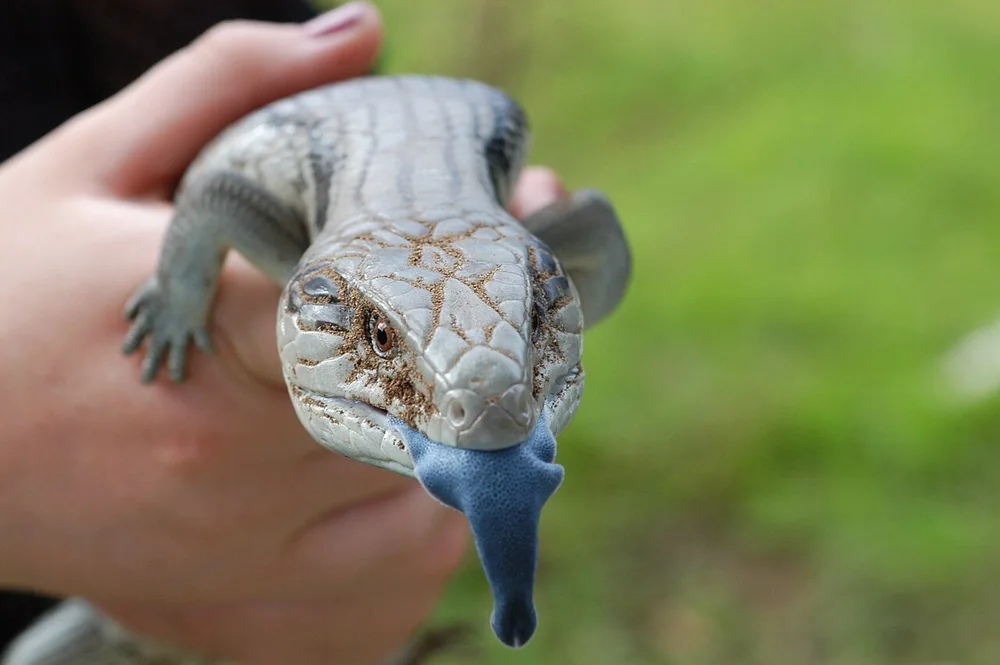
Common blue-tongued skink
Tiliqua scincoides
Photo: Tiliqua scincoides tongue · Doug Beckers · CC BY-SA 2.0 · Changes and credits
These guides provide general husbandry information and do not replace veterinary assessment. If your animal shows symptoms or its condition worsens, contact a veterinarian experienced with exotic animals.
These notices cover the cited provisions, not every possible national or local rule. Check additional requirements with the competent authority.
Description
Tiliqua scincoides is a sturdy skink from Australia and the Tanimbar Islands, with an elongated body, short legs and a blue tongue displayed in defence. Australian forms and T. s. chimaera differ in origin and pattern and inhabit different climates. It is mainly diurnal, terrestrial, omnivorous and live-bearing, using scent while exploring the ground.
Behaviour
Observe individual responses; freezing and repeated flight may indicate distress.
Housing together
Keep one adult per enclosure. Prepare a second terrarium before breeding introductions and separate animals if chasing, biting or exclusion from resources occurs.
Enclosure and climate
Provide a large base with digging substrate, dry retreats and a humid hide. Anchor heavy furnishings and distribute shelters along the thermal gradient. Identify the subspecies: Australian forms and the Tanimbar form have different climatic cycles even within T. scincoides.
Setup
Protect probes and equipment, check escape routes and shelter access and record day and night readings before introducing the animal.
Warm area, cool area and hides
If heating is specified, place it at one end and distribute hides between that area and the cool side. Choose openings and internal space suitable for the body; after adding bedding, check that entrances remain clear. Set the dish on a stable base and leave routes between retreats; use low supports only where suitable for the species.
Burrowing and furnishing stability
Secure rock and platform supports to the floor before adding substrate to the specified depth. Leave a continuous digging area and remove material beside bases as a test: furnishings must remain supported. Complete the digging layer before adjusting lamp heights, as it changes the height the animal can reach.
Testing and access
Connect specified heat sources to compatible thermostats and guard against contact. Secure probes according to device instructions; measure air at resting sites and heated surfaces separately with independent instruments. In housing with water, also check water temperature and quality: one zone’s thermostat does not control the others.
With the complete enclosure running, record day and night readings and compare them with the sheet. Test doors, cable openings and cleaning access, keeping vents clear. Change one variable at a time and recheck after each adjustment.
Lighting and UVB
Daytime UVB with an exposure gradient and opaque retreats; measure at back height.
Daytime UVB with an exposure gradient and opaque retreats; measure at back height.
Humidity and ventilation
T. s. scincoides and T. s. intermedia: 40–60%; T. s. chimaera (Tanimbar): 60–80%
Feeding
Offer a varied omnivorous diet with vegetables, leafy greens and age-appropriate protein; limit fruit and highly caloric foods. Record weight and body condition to adjust portions.
Feeding frequency
Until around 3 months: small meals daily; around 3–8 months: 3 meals weekly; subadults and adults: 1–2 meals weekly, retaining the higher frequency while growth is evident. Measure portions and reduce them if body fat increases.
Supplements
Use diet-appropriate calcium and multivitamins according to the label, coordinating D3 with UVB. Do not combine products without checking their composition.
Daily care
First days
Test climate and access before arrival. Monitor appetite, weight and shelter use with minimal disturbance and quarantine separately from established animals.
Cleaning
Keep animals and equipment away from kitchens and food areas, use tools dedicated to each enclosure and wash your hands with soap and running water after handling animals, food, tank water or furnishings. Quarantine new arrivals separately and agree the duration and checks with a veterinarian before introducing them to established animals.
Handling
Minimise transfers and support the body. Never grab the tail; prepare a secure container before moving the animal.
Checks
Monitor weight, appetite, droppings and skin condition; seek veterinary assessment for weight loss or difficulty moving.
Breeding
Live-bearing species. Establish breeder origin and prepare neonatal housing. Do not apply Australian brumation to T. s. chimaera; introductions need supervision and a female in good condition.
Live-bearing species. Establish breeder origin and prepare neonatal housing. Do not apply Australian brumation to T. s. chimaera; introductions need supervision and a female in good condition.