
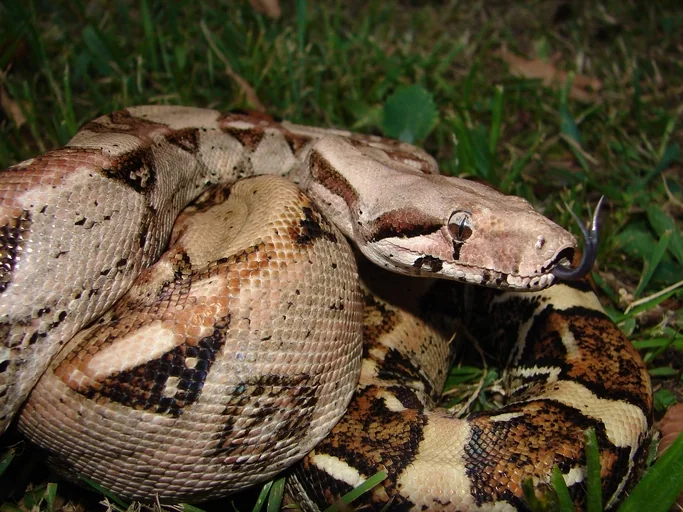
Central American boa
Boa imperator
Photo: Boa constrictor imperator · Esteban Alzate · CC BY-SA 2.5 · Changes and credits
These guides provide general husbandry information and do not replace veterinary assessment. If your animal shows symptoms or its condition worsens, contact a veterinarian experienced with exotic animals.
- Warm zone
- Basking surface: ≈32 °C
- Cool zone
- Cool air: 24–27 °C
These notices cover the cited provisions, not every possible national or local rule. Check additional requirements with the competent authority.
Description
Boa imperator is a boa from Central America and part of northwestern South America. It has a muscular body and dorsal saddles, often with a redder tail. It explores ground and branches, mainly in dimmer hours, kills prey by constriction and gives birth to live young. Size and colour vary greatly with origin.
Behaviour
Observe the individual’s behaviour and limit handling.
Housing together
House animals individually with their own water, food and retreats. Before a breeding introduction, prepare separate accommodation and watch the encounter. Stop persistent pursuit or exclusion from retreats and food; do not leave individuals together when they cannot withdraw from the partner.
Enclosure and climate
Secure furnishings firmly so they support the boa’s weight and allow climbing. Distribute hides, supports and water between the enclosure’s different areas.
Night: 24–26 °C. Basking surface differs from warm-area air (about 27–29 °C).
Setup
Arrange branch fixings so one support can be removed without dismantling the others.
Warm area, cool area and hides
If heating is specified, place it at one end and distribute hides between that area and the cool side. Choose openings and internal space suitable for the body; after adding bedding, check that entrances remain clear. Set the dish on a stable base and leave routes between retreats; use low supports only where suitable for the species.
Testing and access
Connect specified heat sources to compatible thermostats and guard against contact. Secure probes according to device instructions; measure air at resting sites and heated surfaces separately with independent instruments. In housing with water, also check water temperature and quality: one zone’s thermostat does not control the others.
With the complete enclosure running, record day and night readings and compare them with the sheet. Test doors, cable openings and cleaning access, keeping vents clear. Change one variable at a time and recheck after each adjustment.
Lighting and UVB
Ferguson zone not assigned with sufficient precision to this taxon.
One UVI peak is not verified for this entry. Adjusting the installation requires a target for the identified species and origin; the layout should provide screened areas and voluntary light access. A missing number does not establish that UVB is useless.
UVB is recommended at an intensity appropriate to the species, with the option to withdraw from the light. Evidence of its necessity varies between animals: assess exposure alongside diet and species identification.
UVA is recommended as part of daytime lighting, including when UVB has not been shown to be indispensable. Check the UVB source’s spectrum, as it may already emit UVA: a second lamp is not automatically necessary.
Linear UVB tube with reflector, sized once species UVI is established; no single verified percentage for this entry.
For maintenance, a cycle of approximately 12 hours of light and 12 hours of darkness can serve as an initial reference. Use a timer to switch lights off at night, and keep retreats available so the animal can withdraw from light during the day. Adapt day length to species and origin, following the specific guidance for seasonal care and breeding.
Light in the animal’s daily life
The located numeric entry concerns the Sonoran dwarf boa. For B. imperator of another origin, verify the protocol first; maintain a gradient and fully screened hides.
An example layout in the enclosure
To make the layout concrete, take housing measuring 180 × 90 × 120 cm, using the first dimensional configuration in the sheet. This is a mounting example: retain the conditions and any alternatives attached to the stated minimum.
In a wooden enclosure with internal lighting, imagine the tube 115 cm above the floor and the back or head at 75 cm. The geometric distance is therefore 40 cm. The branch or platform lies below animal height, according to body size. Place lighting over one side, with a route to fully screened retreats.
In a glass enclosure with a mesh roof, retain the same animal height and imagine the tube 5 cm above the mesh: distance becomes 50 cm. Mesh attenuates UV variably; ordinary glass roofs block UVB. Increasing the percentage alone is insufficient: measure beneath the mesh and adjust height, output or layout as needed.
These distances describe the example, not a safe clearance for every lamp. First establish a verified UVI target for the identified taxon. Also respect the minimum clearance specified for the model used. Recheck with furnishings, guards and mesh installed, including the highest reachable points and animal growth.
Choosing and checking lighting
First define the patch that should illuminate the whole body and the route to a screened retreat. For a broad patch, select a linear tube with reflector; consider a compact only if its useful patch covers the body and leaves an accessible gradient. Check model, output, reflector and mounting distance, then compare measured UVI with the species target. Label UVB percentage alone cannot determine distance and intensity.
The decisive check uses a UVI meter facing the source at animal height. Check the centre and edges of the exposed patch, the highest supports and retreats, which must allow withdrawal from UV. Repeat after moving equipment, changing lamps and plant growth. Without a meter, use the manufacturer’s instructions and measurements for the exact configuration, including safety clearances.
When UVB or UVA are absent
When UVB is absent, an appropriate whole-prey diet can provide vitamin D3; do not automatically add supplements to prey. Dietary provision does not recreate every effect of light, so retain plans for controlled UVB exposure.
UVA contributes to environmental perception and behaviour and cannot be replaced by vitamins or calcium. A reptile UVB source normally also emits UVA: check its declared spectrum. If the existing lighting lacks it, complete the installation with a suitable source; an ordinary white LED does not guarantee UVA and a UVA-only lamp does not provide UVB.
Humidity and ventilation
Maintain humidity at 55–75%, measured near the cool hide. Measure near hides without letting the hygrometer touch wet bedding, and also inspect substrate beneath retreats. If readings stay outside the specified values, check blocked vents and standing water before adjusting water input; recheck after the change.
Feeding
The diet of Boa imperator is based on whole prey. Mature adults have low requirements; small localities should not be pushed to the size of large boas.
Recommended foods
The tiers describe dietary use: rotate foods within each tier rather than treating them as an absolute nutritional score.
| Food | Dietary role | Benefits and limits | Preparation |
|---|---|---|---|
| Whole captive-bred thawed rodents | Main choices | Skeleton, organs and muscle together supply nutrients absent from meat alone; select prey size according to swallowing ability and the portion specified for the species. | Thaw completely in a refrigerator in a container separate from human food, then warm in a sealed bag in warm water. Do not microwave or refreeze. |
| Small whole captive-bred birds | For rotation | Provide nutritional variety relative to rodents, but species, size and energy content differ: do not replace one prey item with a much larger one. | Thaw completely and replace a meal, rather than adding the bird to the normal ration. Use only when accepted and suited to mouth size. |
| Boneless meat and organs alone | Avoid / not a staple | Do not replace whole prey: muscle meat is calcium-poor and a liver-only diet can supply excessive vitamin A. | Do not use steak, boneless chicken or processed meats as the regular diet. |
| Live rodents | Avoid / not a staple | Live prey can bite and seriously injure the reptile. Its movement does not improve the meal’s nutritional balance. | For animals refusing thawed prey, assess temperature, health and presentation technique before changing prey. |
Meals by age and size
| Stage and size | Frequency | Amount per meal |
|---|---|---|
| Neonates: after the first shed and establishment of feeding | Every 7–10 days | One whole prey item per meal, with a diameter close to the snake’s widest body section and only a slight visible post-meal bulge. Increase prey size gradually; do not stack large prey items to accelerate growth. |
| Juveniles and subadults: until growth slows | Every 10–14 days | One whole prey item per meal, with a diameter close to the snake’s widest body section and only a slight visible post-meal bulge. Increase prey size gradually; do not stack large prey items to accelerate growth. |
| Adults: slowed growth, maintenance | Every 28–56 days as a starting point | One whole prey item per meal, with a diameter close to the snake’s widest body section and only a slight visible post-meal bulge. Increase prey size gradually; do not stack large prey items to accelerate growth. |
Adjusting portions
Weigh before feeding and compare several measurements, not the weight immediately after a meal. Maintain defined muscle without fat folds; extend intervals if weight becomes excessive. Refusal with weight loss, regurgitation or breathing difficulty needs veterinary assessment.
Preparing and offering meals
Thaw completely in a refrigerator in a container separate from human food, then warm in a sealed bag in warm water. Do not microwave or refreeze.
Offer with tongs on a clean surface in its enclosure; avoid moving the snake for every meal. Remove refused prey. Leave undisturbed for at least 48 hours afterwards with continued access to the correct thermal gradient.
Calcium and vitamins
A diet of correctly raised, well-fed whole prey normally does not require calcium or multivitamins added to every meal. Do not inject prey with vitamins or try to compensate for a meat-only diet with improvised doses.
Daily care
First days
Keep retreats accessible and observe without opening them to look for the animal. Check climate readings from outside, offer scheduled food and record actual intake. Prepare the scales and container before weighing so the transfer stays brief; compare weight with earlier records rather than relying on appearance alone.
Cleaning
Keep animals and equipment away from kitchens and food areas, use tools dedicated to each enclosure and wash your hands with soap and running water after handling animals, food, tank water or furnishings. Quarantine new arrivals separately and agree the duration and checks with a veterinarian before introducing them to established animals.
Handling
Before a transfer, prepare an open container and an access route. Allow the animal to enter where possible; if support is necessary, support its body without gripping the tail and minimise time out of the enclosure. Stop repeated attempts to grasp it and allow withdrawal to a retreat.
Checks
Record weight, appetite and behaviour; consult a veterinarian experienced with the species if changes persist. For laboured breathing or wounds, contact them promptly without waiting for symptoms to persist.
Breeding
Sex, maturity and readiness
Confirm B. imperator, origin and sex: a dwarf lineage need not reach the dimensions of a large mainland lineage. Wait for adult development and stable reserves without using frequent meals to reach a preset breeding weight.
Start a record for each breeding animal with identity, origin, documented age and previous weights. Compare the weight trend with growth and body condition; delay introductions for animals still growing rapidly, losing weight or recently acquired. Use stated ages as guidance alongside these checks. If sex cannot be identified reliably, obtain assessment by qualified personnel before pairing.
Preparation and seasonal cycle
Prepare a season appropriate to origin while retaining a gradient that supports digestion. Any light and temperature changes should be gradual; a tropical boa does not automatically follow a temperate colubrid’s cold rest.
Before encounters, prepare and test offspring enclosures and have first foods available. Check records for regular adult feeding and good body condition, then verify access from exposed areas to retreats. If the species protocol includes seasonal changes, adjust settings gradually and record the response. Record night-time air, surface and egg temperatures separately, noting where each is measured. Keep water available throughout preparation.
Courtship and mating
Introduce only identified, compatible adults, with another enclosure ready. Observe from a distance and end the encounter if you observe persistent pursuit, injuries or an animal unable to move away from its partner; do not forcibly separate animals during copulation. Record the date, both identities and what you actually saw: courtship, contact or mating alone does not prove fertilisation.
Pregnancy and preparation for birth
This species gives birth to live young. After observed introductions, separate the male when the female appears pregnant and record ovulation and sheds without palpating the abdomen. Prepare a roomy shelter and cleanable area rather than an egg box.
Gestation and birth
An indicative gestation of 110–150 days is reported; the first observed mating does not necessarily identify the start of development. Maintain thermal choice, water and quiet until birth without attempting to extract offspring or retained material.
Maintain the usual gradient, shelters and free access to water; the female must be able to move away from warmth. Prepare a cleanable surface and observe without repeatedly moving her. Count offspring after birth has finished; do not pull membranes, cords or still-attached young. Remove birth material after the animals have separated.
First meals and juvenile care
After birth and independent separation from membranes, transfer each neonate to clean individual housing. Offer water and shelter; after the first shed provide a proportionate rodent. Record stillbirths and undeveloped material in the mother’s diary as well.
During the first weeks, monitor each youngster: a feeding group does not guarantee that every individual eats. Record intake, droppings and weight at regular intervals to follow growth and adapt housing and food size. Provide separate accommodation if competition prevents an individual from feeding or size differences become marked. Document repeated independent meals before transfer to another keeper.
Female recovery
Keep the mother separate, check that birth has finished and resume manageable meals of the usual diet. Follow recovery of weight and muscle over months, with no new introduction until condition is fully restored.
Equipment and example diary
Prepare the female’s enclosure, dividers or neonatal enclosures according to the species’ social structure, shelters, accessible water, thermostat and probes, scales and first foods. An incubator is unnecessary: reserve space and time for monitoring offspring and mother.
A consistent diary using actual dates helps follow reproduction in Boa imperator. Start with adult identity, weight and condition, then record observed encounters, laying or birth and development conditions. After emergence record the first meal actually accepted and each youngster’s growth while continuing to follow female recovery. Over time these records help identify your lineage’s pattern without turning approximate durations into deadlines.