
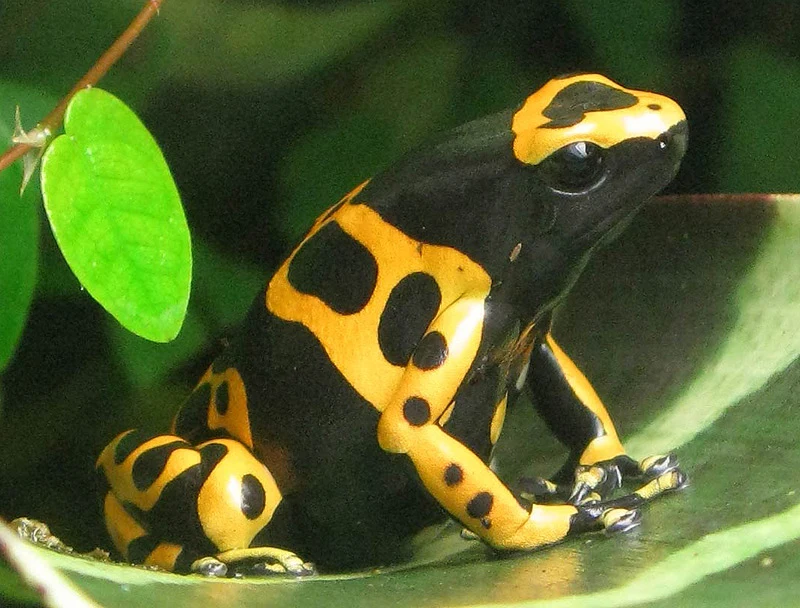
Yellow-banded poison frog
Dendrobates leucomelas
Photo: Leucomelas-brome · Boucaque · CC BY-SA 3.0 · Changes and credits
These guides provide general husbandry information and do not replace veterinary assessment. If your animal shows symptoms or its condition worsens, contact a veterinarian experienced with exotic animals.
These notices cover the cited provisions, not every possible national or local rule. Check additional requirements with the competent authority.
Description
Dendrobates leucomelas is a diurnal frog from northern South America, recognised by yellow or orange bands on black, varying between populations. It lives mainly in leaf litter and low shelters but also climbs vegetation. Males give a conspicuous trilling call and carry tadpoles on their backs.
Behaviour
Observation species; check competition and access to food.
Housing together
Compatible pairs and small groups need several retreats and feeding points; observe new adult introductions. If an animal remains hidden and stops feeding, separate it and investigate competition.
Enclosure and climate
Combine litter and shelters with low branches, plants and climbing surfaces. Spread food across several places and keep foliage cover between stations. High humidity needs drainage rather than stagnant water beneath retreats.
Setup
Protect probes and equipment, check escape routes and shelter access and record day and night readings before introducing the animal.
Warm area, cool area and hides
If heating is specified, place it at one end and distribute hides between that area and the cool side. Choose openings and internal space suitable for the body; after adding bedding, check that entrances remain clear. Set the dish on a stable base and leave routes between retreats; use low supports only where suitable for the species.
Testing and access
Connect specified heat sources to compatible thermostats and guard against contact. Secure probes according to device instructions; measure air at resting sites and heated surfaces separately with independent instruments. In housing with water, also check water temperature and quality: one zone’s thermostat does not control the others.
With the complete enclosure running, record day and night readings and compare them with the sheet. Test doors, cable openings and cleaning access, keeping vents clear. Change one variable at a time and recheck after each adjustment.
Lighting and UVB
Low-level UVB with fully shaded retreats; measure exposure at animal height and prevent access to lamps.
Low-level UVB with fully shaded retreats; measure exposure at animal height and prevent access to lamps.
Humidity and ventilation
70–100%, with moist litter and ventilation
Feeding
Offer cultured fruit flies and springtails, varying tiny invertebrates to suit frog size. Keep backup cultures and check that every animal feeds.
Feeding frequency
Offer small portions daily, checking intake and body condition; newly metamorphosed frogs need readily accessible tiny prey without accumulating waste.
Supplements
Use diet-appropriate calcium and multivitamins according to the label, coordinating D3 with UVB. Do not combine products without checking their composition.
Daily care
First days
Test climate and access before arrival. Monitor appetite, weight and shelter use with minimal disturbance and quarantine separately from established animals.
Cleaning
Keep animals and equipment away from kitchens and food areas, use tools dedicated to each enclosure and wash your hands with soap and running water after handling animals, food, tank water or furnishings. Quarantine new arrivals separately and agree the duration and checks with a veterinarian before introducing them to established animals.
Handling
Avoid routine contact. For transfers use a container or powder-free gloves moistened with treated water; do not grasp limbs or toes.
Checks
Monitor weight, appetite, droppings and skin condition; seek veterinary assessment for weight loss or difficulty moving.
Breeding
Provide sheltered laying surfaces and small water sites for tadpoles carried by males. Maintain separate population records; do not induce intense dry periods as a home breeding stimulus.
Provide sheltered laying surfaces and small water sites for tadpoles carried by males. Maintain separate population records; do not induce intense dry periods as a home breeding stimulus.