
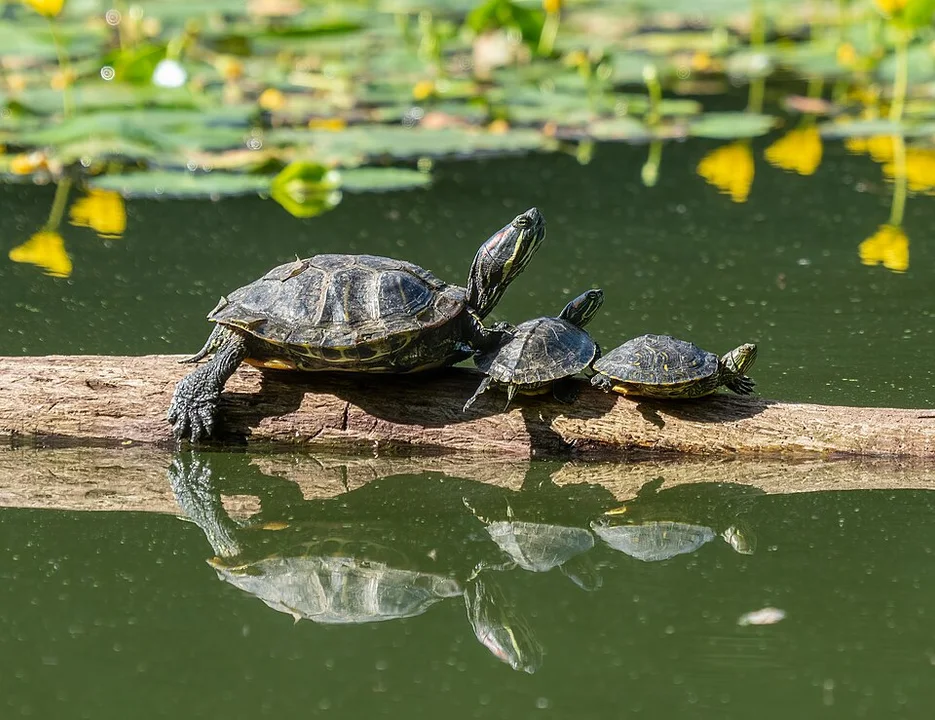
Pond slider
Trachemys scripta
Photo: Pond sliders in Prospect Park (03861) · Rhododendrites · resized / WebP · CC BY-SA 4.0 · Changes and credits
These guides provide general husbandry information and do not replace veterinary assessment. If your animal shows symptoms or its condition worsens, contact a veterinarian experienced with exotic animals.
These notices cover the cited provisions, not every possible national or local rule. Check additional requirements with the competent authority.
Description
Trachemys scripta is a North American freshwater turtle now introduced to many regions worldwide. Subspecies differ in markings behind the eyes and plastron pattern. It is diurnal and alternates swimming with basking on logs and banks; the plant component of its diet generally increases with age.
Behaviour
Activity and tolerance of contact vary between individuals. Prioritise observation and assess each animal’s response.
Housing together
Prefer one turtle per tank. Males and females together may experience pursuit and biting; stacking on the basking area does not establish good welfare together. Do not add other species or keep small turtles with adults. In shared housing each animal must independently reach the surface, food and dry platform; biting or blocked access requires separate tanks, not merely extra furnishings.
Enclosure and climate
Provide filtered water, retreats and supports for reaching the surface. A ramp must connect the water to a fully dry platform. Start young turtles in easily accessible shallow water and increase depth according to swimming ability.
values for T. s. elegans; air refers to the basking area. Check other subspecies. Keeping rules depend on jurisdiction.
Setup
Install the specified equipment and check joints for leaks. Prepare a siphon and separate containers for new and removed water; treat water before use.
Water and land areas
Secure the land area before filling the tank. Connect it to water with a textured stable ramp and intermediate supports reachable from the bottom. Test the wet ramp: it must not slip, tip or trap the animal. Add water to the level specified for species, size and swimming ability without submerging the dry resting area; tank height does not indicate safe depth.
Testing and access
Connect specified heat sources to compatible thermostats and guard against contact. Secure probes according to device instructions; measure air at resting sites and heated surfaces separately with independent instruments. In housing with water, also check water temperature and quality: one zone’s thermostat does not control the others.
With the complete enclosure running, record day and night readings and compare them with the sheet. Test doors, cable openings and cleaning access, keeping vents clear. Change one variable at a time and recheck after each adjustment.
Lighting and UVB
Zones 3–4: intermediate assignment between exposed basking and intense sunlight.
At the exposed position aim for approximately UVI 3–4, measured at the shell. The animal must choose its exposure and reach UVI 0 retreats. This local target differs from the Ferguson ecological band and should not be maintained everywhere throughout the day.
UVB is essential in indoor housing. Outdoors, direct sunlight can provide it if shade is always accessible. Select the lamp to achieve the appropriate UVI at the positions the animal uses.
UVA is recommended as part of daytime lighting, including when UVB has not been shown to be indispensable. Check the UVB source’s spectrum, as it may already emit UVA: a second lamp is not automatically necessary.
Linear UVB tube with reflector. Indicative UVB percentage stated on the lamp: 5–7%; final selection depends on UVI achieved at the actual distance.
For maintenance, a cycle of approximately 12 hours of light and 12 hours of darkness can serve as an initial reference. Use a timer to switch lights off at night, and keep retreats available so the animal can withdraw from light during the day. Adapt day length to species and origin, following the specific guidance for seasonal care and breeding.
Light in the animal’s daily life
The assignment covers the elegans and scripta forms listed in the table. Measure above the shell in a fully dry body-sized area with free access back to water.
An example layout in the enclosure
The sheet does not establish one minimum height. To explain mounting alone, imagine lighting supports 60 cm high: this illustrative height does not set minimum housing dimensions. Aggregated entries require species identification first.
In a wooden enclosure with internal lighting, imagine the tube 55 cm above the floor and the top of the shell at 25 cm. The geometric distance is therefore 30 cm. The branch or platform lies below animal height, according to body size. Place lighting over one side, with a route to fully screened retreats.
In a glass enclosure with a mesh roof, retain the same animal height and imagine the tube 5 cm above the mesh: distance becomes 40 cm. Mesh attenuates UV variably; ordinary glass roofs block UVB. Increasing the percentage alone is insufficient: measure beneath the mesh and adjust height, output or layout as needed.
These distances describe the example, not a safe clearance for every lamp. Select the source and adjust mounting until approximately UVI 3–4 is measured at animal height in the exposed position. Also respect the minimum clearance specified for the model used. Recheck with furnishings, guards and mesh installed, including the highest reachable points and animal growth.
Choosing and checking lighting
First define the patch that should illuminate the whole body and the route to a screened retreat. For a broad patch, select a linear tube with reflector; consider a compact only if its useful patch covers the body and leaves an accessible gradient. Check model, output, reflector and mounting distance, then compare measured UVI with the species target. Label UVB percentage alone cannot determine distance and intensity.
The decisive check uses a UVI meter facing the source at animal height. Check the centre and edges of the exposed patch, the highest supports and retreats, which must allow withdrawal from UV. Repeat after moving equipment, changing lamps and plant growth. Without a meter, use the manufacturer’s instructions and measurements for the exact configuration, including safety clearances.
When UVB or UVA are absent
If the UVB source fails, restore the installation and recheck the exposed area. Oral D3 may be considered as temporary support but is not a complete or universally safe replacement. Consider calcium, D3, diet and animal condition together: avoid improvised extra doses.
UVA contributes to environmental perception and behaviour and cannot be replaced by vitamins or calcium. A reptile UVB source normally also emits UVA: check its declared spectrum. If the existing lighting lacks it, complete the installation with a suitable source; an ordinary white LED does not guarantee UVA and a UVA-only lamp does not provide UVB.
Feeding
Trachemys scripta: omnivorous, with regularly offered edible leaves and aquatic plants even when juveniles prefer animal foods. Portions add up over the week: pellets, worms and other foods are not extra meals.
Recommended foods
The tiers describe dietary use: rotate foods within each tier rather than treating them as an absolute nutritional score.
| Food | Dietary role | Benefits and limits | Preparation |
|---|---|---|---|
| Complete aquatic turtle pellets | Main choices | Provides vitamins and minerals in a repeatable formulation; choose a complete product suited to growth stage, not dried shrimp alone. | Offer in water in swallowable sizes; use sinking pellets for bottom-foraging species. Follow the manufacturer’s portion and remove leftovers. |
| Cultured earthworms and small aquatic snails | For rotation | These feeders diversify the animal component of the diet and encourage foraging. They do not provide a complete diet on their own. | Use only feeders from clean cultures free of pesticides and molluscicides, in sizes that are easy to swallow. Do not collect molluscs from unknown waters. |
| Chicory, endive, dandelion and other edible leaves | Main choices | Supply fibre and varied minerals with lower energy density than fruit and seeds. Rotate plant species: no single leaf balances the whole diet. | Identify plants, wash and cut into manageable pieces. Avoid treated plants, unidentified ornamentals and iceberg lettuce as the only green. |
| Dried shrimp alone or meat alone | Avoid / not a staple | A monotonous diet of these foods does not cover mineral and vitamin balance; palatability does not mean completeness. | Do not use instead of complete pellets and the planned variety. |
Meals by age and size
| Stage and size | Frequency | Amount per meal |
|---|---|---|
| Young: first year and rapid growth | One small meal daily; edible leaves available daily | Initially measure dry pellet volume: roughly the head volume excluding the neck is a practical estimate to adjust against the label and weight trend. Invertebrates replace some pellets rather than being extra. Remove uneaten food within 15–20 minutes. |
| Subadults: after the first year, still growing | Concentrated foods every other day; adjust to growth | Initially measure dry pellet volume: roughly the head volume excluding the neck is a practical estimate to adjust against the label and weight trend. Invertebrates replace some pellets rather than being extra. Remove uneaten food within 15–20 minutes. |
| Adults: stable size | Pellets or animal foods 2–3 times weekly; leaves daily | Initially measure dry pellet volume: roughly the head volume excluding the neck is a practical estimate to adjust against the label and weight trend. Invertebrates replace some pellets rather than being extra. Remove uneaten food within 15–20 minutes. |
Adjusting portions
Record the amount and type of food eaten, leftovers and weight trend. Compare weight with growth and body condition rather than judging by appetite alone. Adjust the overall portion for the life stage gradually: pellets, plants and prey are not added as extra meals. Investigate unexpected weight loss before increasing food.
Preparing and offering meals
Feed in clean water where swallowing is possible; use long tongs and monitor intake. Do not repeatedly transfer an animal if this disrupts feeding; remove leftovers with a siphon.
Calcium and vitamins
Complete pellets already contain calcium and vitamins: do not automatically dust them. Powder dispersed in water does not deliver a reliable dose. If prey or homemade foods predominate, a specific supplementation plan is needed; UVB and diet remain complementary.
Daily care
First days
Record identity, origin and documents and prepare separate housing. Before arrival, check that water and shelter are reachable and closures are secure. Offer the planned diet and record intake, leftovers and weight; compare records without repeatedly moving the animal for inspection.
Cleaning
Keep animals and equipment away from kitchens and food areas, use tools dedicated to each enclosure and wash your hands with soap and running water after handling animals, food, tank water or furnishings. Quarantine new arrivals separately and agree the duration and checks with a veterinarian before introducing them to established animals.
Handling
Support shell and limbs during transfers without turning the animal over; limit contact.
Checks
Shell lesions, breathing difficulty, weakness or weight loss warrant veterinary assessment.
Breeding
Sex, maturity and readiness
Biology: males generally mature earlier and at smaller sizes than females; long tails and developed foreclaws help sex them. Domestic breeding of this species is prohibited in Italy. This chapter explains the cycle to recognise laying and manage existing animals, rather than inviting pairing.
Preparation and seasonal cycle
For management in Italy, keep sexes separate and prevent escape and reproduction. Do not change light or temperature to stimulate mating. Females may lay without a male present and still need a suitable site to prevent egg retention.
Recognising courtship and separating sexes
Courtship can include vibrating the foreclaws in front of the female’s face. Recognise this behaviour and separate sexes in animals kept in Italy; do not arrange breeding encounters. Laying does not prove recent mating because females may retain sperm.
Before laying and the nest
Still provide females with moist diggable soil out of water and safe access. Biologically, clutches may contain about 5–20 eggs and recur within a season. If eggs are found, record them and arrange management with a veterinarian or competent facility; do not start domestic incubation or release them into the environment.
Maintain a suitable laying site even without a male: females can produce unfertilised eggs. Persistent straining without laying, weakness or tissue protruding from the vent require prompt veterinary assessment. Do not wait for a predicted laying date if these signs appear. Do not squeeze the abdomen, pull eggs or give drugs to induce laying without veterinary direction.
Natural development and managing discovered eggs
Natural hatching depends on temperature, moisture and origin; durations of around 60–91 days are described, which do not constitute incubation instructions. Sex depends on temperature during development. In Italy management prioritises preventing new offspring; no operational incubation programme is proposed.
First meals and juvenile care
For offspring already present, use secure housing with supports, dry exits, clean water and protected intakes; follow the profile’s juvenile diet. Record number and origin and contact a competent facility for management. Do not release animals or arrange transfers without checking applicable procedures.
During the first weeks, monitor each youngster: a feeding group does not guarantee that every individual eats. Record intake, droppings and weight at regular intervals to follow growth and adapt housing and food size. Provide separate accommodation if competition prevents an individual from feeding or size differences become marked. Document repeated independent meals before transfer to another keeper.
Female recovery
After laying, monitor female weight, appetite and activity, offer her usual diet and retain access to diggable nesting ground. Keep sexes separate and record later clutches. Persistent straining or weakness require veterinary attention.
Equipment and example diary
Prepare separate secure housing, diggable ground for the female, scales and records. Record identity, origin, laying and advice received for managing eggs. For offspring already present, arrange housing with the competent facility.